
Oct 16, 2026Success Stories / Case Studies
Should Lip Liner Shade Samples Be Reviewed in Batches?
A real 12-shade lip liner project explains when reviewing the first completed samples can reduce rework without replacing final approval of every shade.
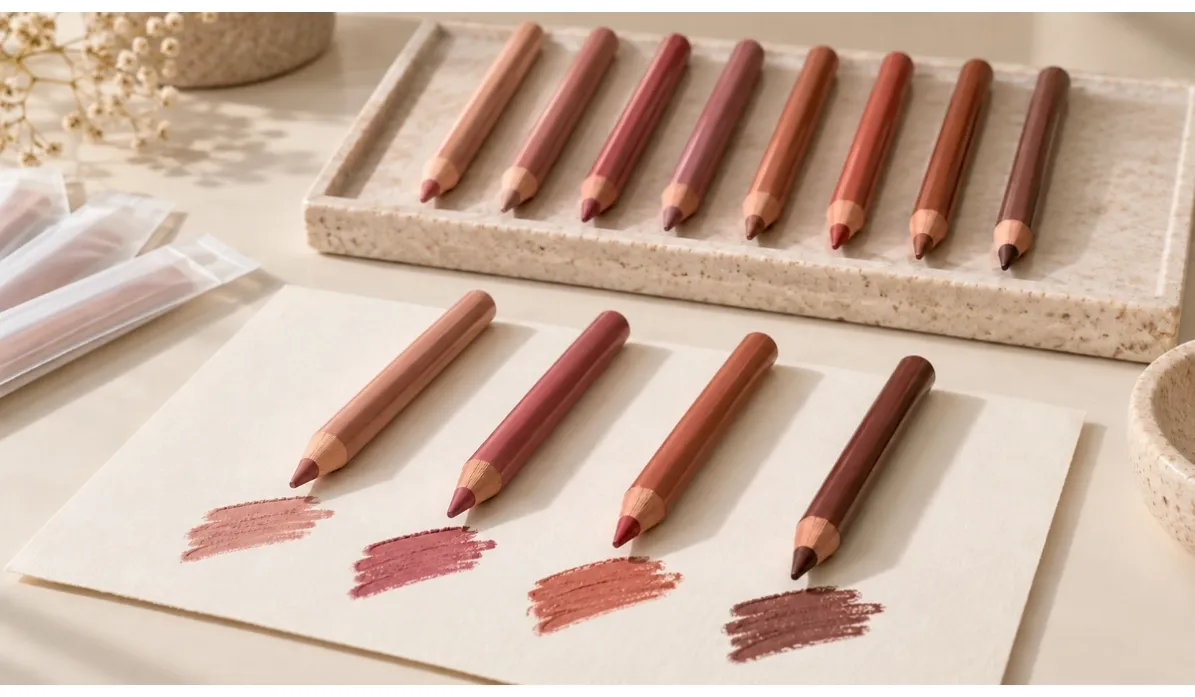
A recent private label wooden lip liner project involved 12 custom shades developed from physical reference pencils supplied by the buyer.
The first four shade samples were completed while the remaining eight were still being prepared.
This created a practical project-management question:
Should the manufacturer send the first four samples for review immediately, or wait until all 12 shades are ready?
For a multi-shade color cosmetics project, reviewing an initial group can be useful. It allows the buyer and manufacturer to verify the shade-matching method, application performance and product construction before every sample has been completed.
However, approving the first four shades does not automatically approve the complete collection. Every final shade still needs to be evaluated individually.
The First Samples Establish More Than Color
The purpose of the first sample group is not simply to ask whether four colors are correct.
It can also confirm whether both teams are using the same evaluation standard.
For a wooden lip liner, the first samples may answer several broader questions:
- Is the undertone being interpreted correctly?
- Is the color payoff close to the physical reference?
- Does the pencil feel too hard or too soft?
- Is the application smooth enough?
- Is the line precise or too creamy?
- Does the surface finish of the pencil match the brand direction?
- Are the shade codes and samples clearly identified?
- Is the buyer’s feedback detailed enough for the next round?
If a common issue appears across the first four samples, the development team can review it before the same issue affects all 12 shades.
This is different from approving a shade based on photographs. Our earlier case study explains why physical shade samples matter in private label lip liner development.
Why Waiting for All 12 Samples May Create More Rework
Waiting for the complete shade range can seem more efficient because the buyer receives everything in one shipment.
But if the development direction is not yet fully aligned, completing every shade before receiving feedback may create unnecessary revisions.
For example, the buyer may discover that:
- the shades are generally too warm;
- the payoff is lighter than expected;
- the pencil texture needs more glide;
- the wooden barrel should use a different surface finish;
- the shade coding system is unclear;
- the reference comparison method needs to change.
If those issues affect the entire range, discovering them after all 12 samples are completed means more samples may need to be adjusted.
An early review creates a checkpoint.
It does not guarantee that the remaining shades will be approved immediately, but it gives both teams an opportunity to correct the overall direction before the project moves further.
When Batch Review Works Best
Reviewing lip liner samples in stages works best when the first group is representative of the wider collection.
The initial group should ideally include different shade directions, such as:
- a light nude;
- a medium neutral;
- a deeper brown;
- a shade with a red, mauve or cool undertone.
If the first four samples are almost identical, they may not reveal how accurately the manufacturer is interpreting the complete shade range.
A representative first group helps evaluate whether the development method works across different color depths and undertones.
Every Shade Still Requires Individual Approval
A successful first group does not remove the need to review the remaining colors.
Even when all shades use the same basic formula and pencil structure, pigment combinations can affect:
- color payoff;
- undertone;
- hardness;
- glide;
- coverage;
- appearance on skin;
- consistency with the reference.
One brown shade may be approved while another appears too red. One nude may apply smoothly while a deeper shade needs adjustment.
For that reason, final approval should be recorded by individual shade code—not by a general statement such as “the collection looks good.”
Our lip liner sample approval checklist covers shade, texture, pencil finish, branding and packaging details that should be confirmed before bulk production.
Use Clear Shade Codes From the Beginning
Managing 12 samples through descriptions such as “the dark brown,” “the second nude” or “the pink one” creates avoidable confusion.
Each reference and each laboratory sample should have a unique code.
A practical tracking system may include:
Reference Code | Sample Version | Status | Buyer Feedback |
|---|---|---|---|
Shade 01 | V1 | Approved | Match confirmed |
Shade 02 | V1 | Revise | Reduce red undertone |
Shade 03 | V2 | Pending | Awaiting buyer test |
Shade 04 | V1 | Revise | Increase payoff |
The code should remain consistent across:
- the buyer’s reference pencil;
- the manufacturer’s development record;
- the physical sample;
- the approval document;
- the artwork;
- the bulk production order;
- the finished-product shade label.
Clear sample identification becomes increasingly important as the number of shades and revision rounds grows.
Feedback Should Describe the Required Change
Comments such as “not close enough” or “please improve the color” do not give the laboratory a precise direction.
More useful feedback would be:
- slightly reduce the red undertone;
- make the shade more neutral;
- increase the brown depth;
- improve payoff in the first stroke;
- keep the color but make the texture slightly smoother;
- match the reference more closely after one application rather than several layers.
When possible, the buyer should compare the factory sample and the reference under similar lighting and apply both to the same testing surface.
This reduces the chance that lighting, photography or different application methods influence the decision.
Vague feedback is one of the main reasons sample rounds continue longer than expected. The same principle is explained in Why Do Skincare Samples Keep Getting Revised?. Although that article focuses on skincare, the need for specific and measurable feedback also applies to color cosmetics.
Commercial Details Can Progress at the Same Time
Reviewing the first four shades does not mean the rest of the project must stop.
While the remaining shade samples are being prepared, the buyer and manufacturer can confirm commercial details that do not depend on final color approval.
These may include:
- total number of shades;
- estimated quantity per shade;
- total order quantity;
- wooden pencil dimensions;
- barrel and cap structure;
- surface coating;
- logo printing;
- shade name and code placement;
- individual packaging;
- master carton requirements;
- target production schedule.
Confirming these details in parallel can reduce delays after shade approval.
It also helps the manufacturer prepare a more accurate quotation. A color cosmetics price depends on more than the formula. Shade count, production quantity, printing, pencil finish and packaging configuration may all affect the final cost.
For a broader explanation of how packaging design and shade splits influence production quantities, see Why Color Cosmetic MOQ Is Often Set by Packaging Design—Not by Shade.
Do Not Finalize the Order Before the Product Specification Is Clear
Commercial planning can proceed during sampling, but the final production order should still be based on confirmed specifications.
Before bulk production, both sides should agree on:
- approved shade list;
- quantity per shade;
- pencil formula and texture;
- barrel finish;
- cap color;
- logo and printing;
- shade names and codes;
- packaging configuration;
- unit price;
- payment terms;
- production lead time;
- inspection standard.
A preliminary price based on incomplete information may change once the final packaging and shade quantities are confirmed.
This is why a useful OEM quotation should be linked to a defined product configuration, rather than treated as a price for “a lip liner” in general. Related guidance is available in How Should Beauty Brands Set a Target Cost Before Asking for an OEM Skincare Quote?. The same commercial logic applies to color cosmetics.
A Practical 12-Shade Development Process
A controlled development sequence may look like this:
1. Register all physical references
Count the unique colors, assign reference codes and record any duplicate pencils before sampling begins.
2. Select a representative first group
Choose several shades with different depths and undertones rather than selecting four very similar colors.
3. Produce the first samples
Evaluate not only color, but also texture, payoff, pencil construction and surface finish.
4. Send the first group for early review
Ask the buyer to provide specific feedback by shade code.
5. Continue the remaining shades
Apply any confirmed general adjustments to samples that have not yet been finalized.
6. Review every shade individually
Record approval or revision requirements for each color.
7. Confirm packaging and commercial specifications
Lock the pencil finish, printing, quantity per shade, packaging and final price.
8. Approve a final production reference
Keep an approved reference for every shade that can be used during bulk production and quality control.
The project should move into mass production only after the shade references and complete product specification are clear.
Early Review Is a Control Point, Not a Shortcut
Sending the first four completed samples before all 12 are ready is not about pressuring the buyer to approve the collection faster.
It is a way to verify that the project is moving in the correct direction.
For a multi-shade lip liner range, an early sample group can reveal whether the manufacturer and buyer agree on:
Shade matching + Texture + Payoff + Pencil finish + Feedback method
Once that foundation is confirmed, development of the remaining shades becomes more controlled.
The first group provides direction. The final approval still belongs to every individual shade.
BEGO Beauty supports private label wooden lip liner and color cosmetics projects, including physical shade matching, formula sampling, barrel finishing, logo printing, packaging and bulk production coordination.
View our 12-shade wooden lip liner development case or contact BEGO Beauty to discuss your color cosmetics project.