
Sep 22, 2026Private Label Guides
Why Color Cosmetic MOQ Is Often Set by Packaging Design—Not by Shade
Learn how color cosmetic MOQ is calculated by packaging design, product and shade—and how brands can split 12,000 units across 2–3 shades.
Yesterday, we received an OEM/ODM inquiry for a new private label color cosmetics line. The requested range included lipstick, liquid eyeliner, mascara, lip gloss or lip oil, foundation or concealer, and eyeshadow.
The buyer asked the right questions: What is the MOQ per product? Is there a separate MOQ for each shade? What stock formulas and packaging are available? How long do samples and production take?
Before sending a full catalogue and price list, however, we needed to clarify one point that would determine whether the project was commercially workable:
For many of the products requested, the standard MOQ is 12,000 pieces per packaging design—but the filling can normally be divided into two or three shades.
That distinction changes how a brand should plan its first order.
“Per Packaging Design” Is Not the Same as “Per Shade”
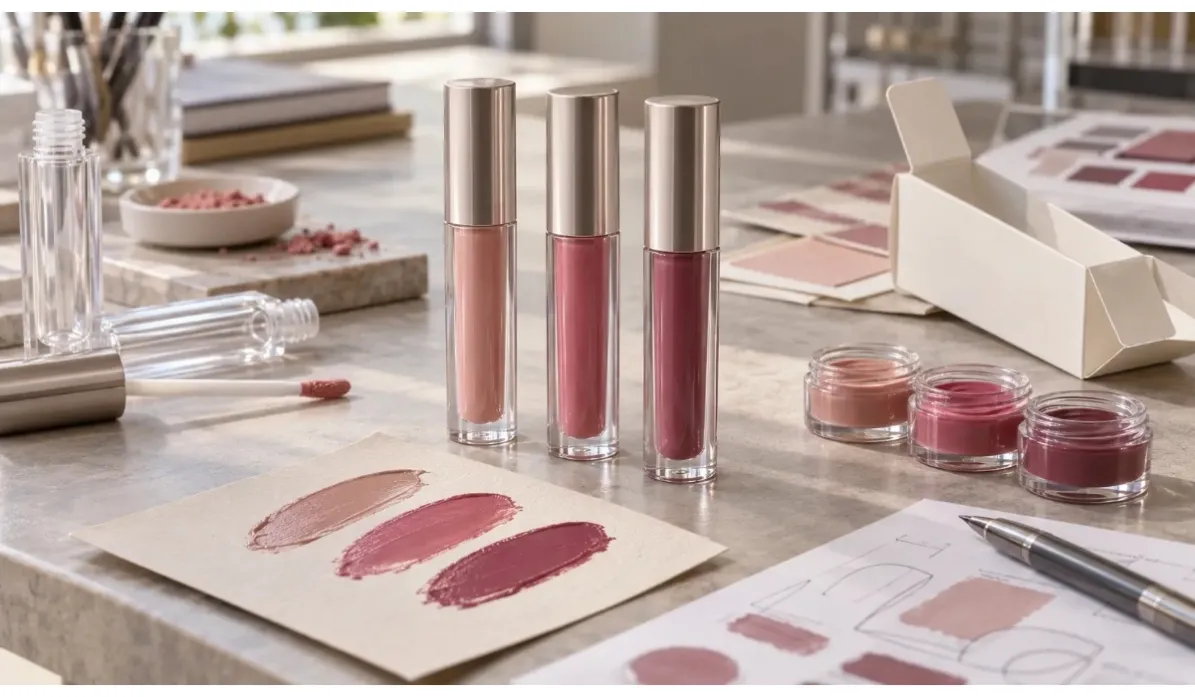
Suppose a brand wants to launch a private label lip gloss with one tube design, one cap color and the same printed logo across the range.
A 12,000-piece production could potentially be arranged as:
- 2 shades × 6,000 pieces; or
- 3 shades × 4,000 pieces.
The shades can be identified by a bottom label, shade name or shade code while the main packaging remains consistent.
This is different from ordering three completely different tube colors or three separate printed artworks. Once each shade requires its own decorated packaging version, the packaging supplier may treat them as separate production designs, with separate setup requirements and possibly separate MOQs.
Why Packaging Often Sets the First Threshold
Custom color cosmetics packaging involves more than purchasing an empty tube or bottle. Logo printing, hot stamping, UV printing, color coating, mold setup and outer-carton production all involve preparation time and material loss.
The packaging factory must run enough units to make that setup efficient and maintain consistent color and print quality. This is why a small filling quantity does not automatically mean that an equally small quantity of fully customized packaging is available.
Brands can review our current private label skincare and color cosmetic products before selecting the first items for quotation.
Shade Splitting Also Has Production Limits
Using one packaging design does not mean an order can be divided into an unlimited number of shades.
Every shade requires color matching, a confirmed sample, raw-material preparation, bulk mixing, filling-line adjustment, cleaning and quality checks. If 12,000 pieces were divided into six or eight very small shade batches, the operational cost and production loss per shade would increase substantially.
For many products, two or three shades provide a more practical balance between assortment and production efficiency. The exact arrangement still depends on the product type, formula, packaging and filling process.
Foundation requires additional care because the shade range may need to cover several undertones and skin-tone depths. Mascara, eyeliner, lipstick and lip gloss also have different filling and formula requirements. A shade split that works for one product should not automatically be applied to every category.
Why We Asked the Buyer to Prioritize 2–3 Products
The original inquiry covered six product categories. Preparing formulas, packaging combinations and accurate pricing for all six before confirming the MOQ would create a large amount of information—but not necessarily a useful launch plan.
For a first collection, it is often better to choose two or three products that fit the brand's positioning and sales channels. The manufacturer can then prepare:
- suitable stock or customizable formulas;
- realistic packaging options;
- a proposed shade structure;
- sample costs and lead times;
- preliminary unit pricing based on the actual configuration.
BEGO Beauty's OEM/ODM manufacturing services cover formula selection, shade development, packaging sourcing, sampling and production coordination.
What Information Is Needed Before an Accurate Quote?
For a color cosmetics quotation, a product name alone is not enough. The manufacturer should also understand:
- the priority products for the first launch;
- the number of shades required for each product;
- whether all shades can share one packaging design;
- the preferred formula or finish;
- the target retail price and sales market;
- whether stock packaging or fully customized packaging is preferred;
- the brand's planned launch date.
A company website or active social media page is also useful. It helps the manufacturer understand the brand's positioning, customer profile and visual direction before recommending formulas and packaging.
The Practical Starting Point
For this inquiry, our first step was not to send a generic price list. It was to confirm whether the 12,000-piece MOQ was workable and ask the buyer to identify the two or three products they wanted to prioritize.
That approach protects both sides. The buyer avoids spending time reviewing unsuitable options, while the manufacturer can prepare recommendations based on a realistic order structure.
A well-planned color cosmetics launch does not necessarily need a large number of products or shades. It needs a clear hero-product strategy, a packaging system that can be shared efficiently and enough volume per shade to support reliable production.
If you are planning a private label makeup line, contact BEGO Beauty with your priority products, expected shade count, target quantity and packaging direction. We can help you evaluate the most practical MOQ structure before quotation and sampling.