
Sep 8, 2026Manufacturing & Quality
Why Filling Accuracy Matters in Skincare Manufacturing
Learn why filling accuracy matters in skincare manufacturing and how it affects product consistency, cost control, customer experience and bulk production quality.
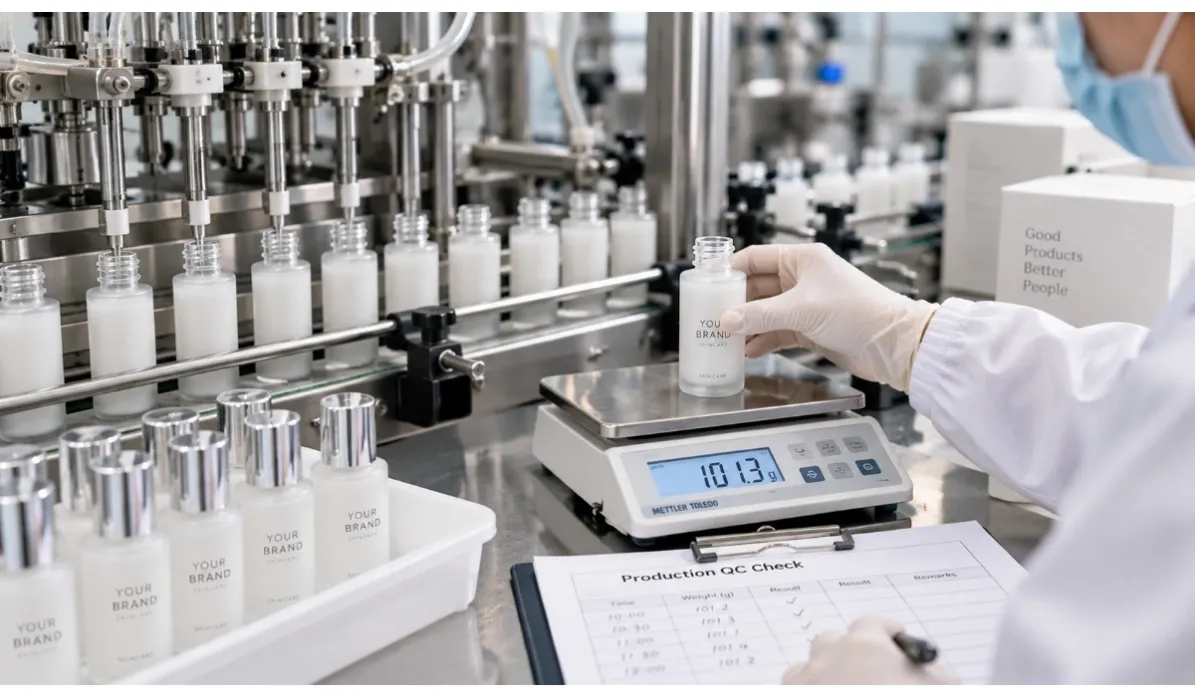
During a factory visit, one client spent more time watching the filling station than I expected.
At first, I thought they were simply curious about the machine.
Then they asked:
“How do you make sure every bottle receives the same amount?”
It sounds like a small detail.
But in skincare manufacturing, filling accuracy can affect much more than the appearance of one bottle.
For a beauty brand producing hundreds or thousands of units, small filling differences can quickly become a consistency, cost and customer-experience issue.
One Bottle Is a Small Difference. One Batch Is Not.
If one serum bottle is filled slightly over target, the difference may not look important.
But across 5,000 units, repeated overfilling means more formula is being used than planned.
That affects material consumption and production cost.
Underfilling creates a different risk.
Customers may notice that one bottle appears to contain less than another, or the finished product may not match the declared net content standard expected for the project.
This is why filling is not simply the step between “formula finished” and “packaging complete.”
It is part of production control.
Consistency Is What the Customer Eventually Sees
Consumers rarely think about filling accuracy when a product is made well.
They simply expect every bottle to feel the same.
The same fill level.
The same product presentation.
The same experience when they open the package.
That consistency is especially important for brands selling through retail, e-commerce or subscription channels, where customers may purchase the same product repeatedly.
A visibly inconsistent batch can weaken confidence in the brand, even when the formula itself is good.
Why the Formula Matters to the Filling Process
Not every skincare product behaves the same way on a filling line.
A lightweight toner is very different from a thick cream.
A serum with higher viscosity may flow differently from a watery essence.
Foaming products can also create their own filling challenges.
So filling control is not only about setting one machine number and pressing start.
The manufacturer needs to consider the actual formula, container and dispensing system together.
A beautiful bottle is useful only if the formula can be filled into it consistently and cleanly.
What Buyers Rarely See
During the same client visit, the conversation became less about the filling machine itself and more about what happens around it.
How is fill quantity checked?
How often is it checked?
What happens if the result starts drifting?
Are bottles inspected for leakage or residue around the neck?
These are the kinds of questions that tell a buyer much more than simply asking how fast the line can run.
Production speed matters.
But controlled production matters more.
Filling Accuracy Also Protects Cost
For brands, formula is one of the major cost components of a skincare product.
If a factory consistently overfills every unit, the buyer is indirectly paying for material that was never planned into the commercial model.
If the factory underfills, the brand may face quality complaints or rework.
Neither outcome is good.
The ideal situation is not “fill as much as possible.”
It is:
Fill consistently according to the approved production standard.
That is better for the manufacturer, the buyer and the end customer.
A Small Detail That Says a Lot About Manufacturing Discipline
Filling accuracy is not the most glamorous part of skincare production.
It will never be the part of the project that appears on the front of the packaging.
But it is one of those manufacturing details that reveals how seriously a factory treats consistency.
For beauty brands working with an OEM/ODM skincare manufacturer, this is worth asking about before bulk production begins.
Because when filling accuracy is controlled properly, customers may never notice it.
But when it is not, they often notice very quickly.
At BegoBeauty, filling is only one part of the wider private label skincare production process, together with formula approval, packaging confirmation and final quality control.
For buyers, the useful question is not simply:
“How many units can you fill per day?”
It is:
“How do you make sure the units you fill stay consistent?”