
Sep 14, 2026Industry Insights & Trends
Why More Beauty Brands Are Choosing Simpler Packaging for First Product Launches
Learn why many beauty brands start with simpler skincare packaging to reduce MOQ, cost, lead time and inventory risk before scaling.
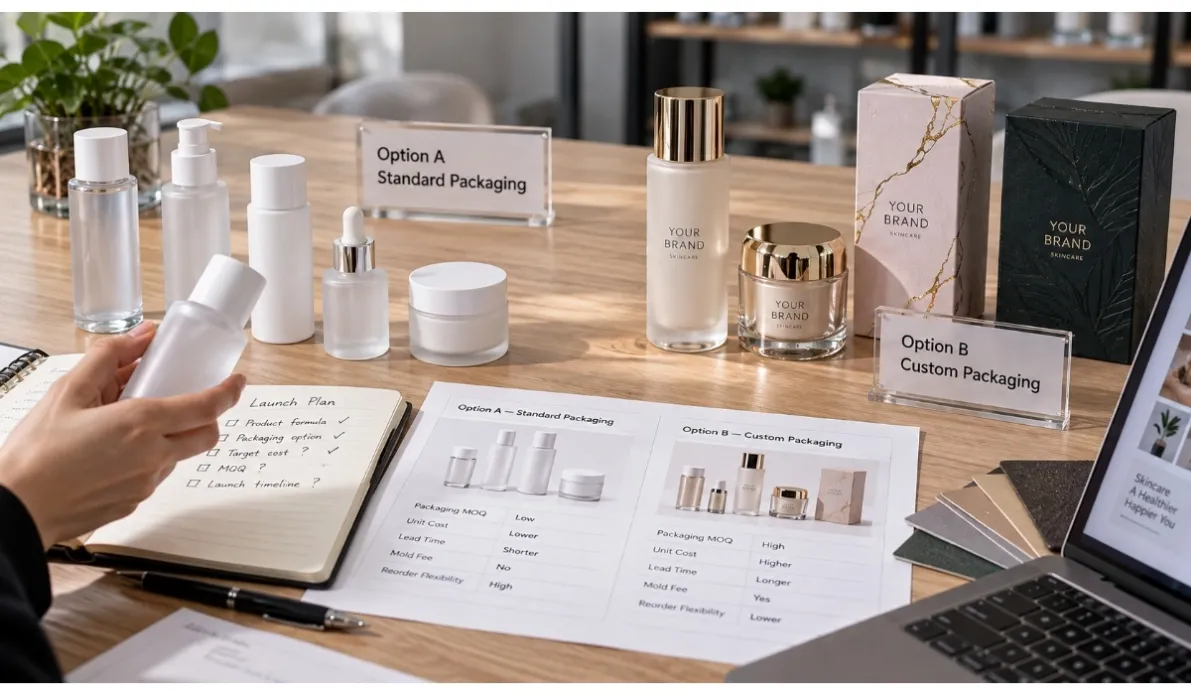
A few years ago, “premium packaging” often meant adding more.
More structure.
More printing.
More decorative finishes.
More custom parts.
But in recent skincare projects, I have noticed a different kind of conversation happening.
New beauty brands are asking:
“What is the simplest packaging that still looks professional and supports the brand?”
That is not necessarily a step backward.
In many cases, it is a smarter first-launch decision.
The problem is not the design — it is what the design creates
A custom bottle can look excellent.
But it may also bring:
- higher packaging MOQ
- longer development time
- more tooling or setup cost
- more packaging inventory
- higher freight volume
- more risk if the first launch underperforms
For an established brand with proven demand, that investment may make sense.
For a first launch, it can put too much cash into packaging before the market has validated the product.
A standard bottle does not have to look generic
This is one of the biggest misunderstandings I see.
Brands sometimes assume:
standard packaging = cheap-looking product
That is not true.
A mature stock bottle can still be differentiated through:
- color
- printing
- label design
- outer box
- finish
- brand photography
- overall visual direction
Sometimes the brand identity comes more from how the packaging is used than from whether the bottle itself was custom-molded.
One recent sourcing discussion made this very clear
In a recent skincare project, the buyer had several products under consideration.
Before we moved too far into packaging development, the more important questions were:
How many SKUs will launch first?
What quantity is realistic per SKU?
What target cost needs to work?
Only after those questions were clear did packaging choices become meaningful.
That is why I increasingly think packaging should follow the commercial plan — not lead it.
Simpler packaging can also help with reorders
This is another benefit new brands often overlook.
If the first product sells faster than expected, a mature packaging option may be easier to reorder.
That can reduce the risk of waiting for:
- special molds
- custom components
- complex printing
- unusual structures
For a growing brand, reorder flexibility can be more valuable than having the most unique bottle on day one.
When does custom packaging make more sense?
Simpler packaging is not always the right answer.
Custom packaging becomes more interesting when:
- the brand already has stable demand
- packaging is central to the brand identity
- expected volume supports the MOQ
- repeat orders are predictable
- the margin can support the investment
At that stage, packaging can become a stronger differentiation tool.
But the timing matters.
Good Packaging Should Support the Business Model
For a first launch, I would not ask:
“What is the most premium packaging we can make?”
I would ask:
“What packaging gives the product a strong brand presentation without creating unnecessary MOQ, cost or inventory risk?”
That usually leads to a much more practical product-development conversation.
At BegoBeauty, we work with private label skincare and color cosmetics projects from formula and packaging selection through bulk production.
For new beauty brands, we often find that starting with the right balance of formula, packaging and quantity creates more room to scale later.