
Oct 4, 2026Success Stories / Case Studies
Why Soft Lip Liner Formulas Cannot Be Copied Into Wooden Pencils
A real lip liner case explains why soft benchmark formulas must be adjusted for wooden pencils—and why shade payoff may change.
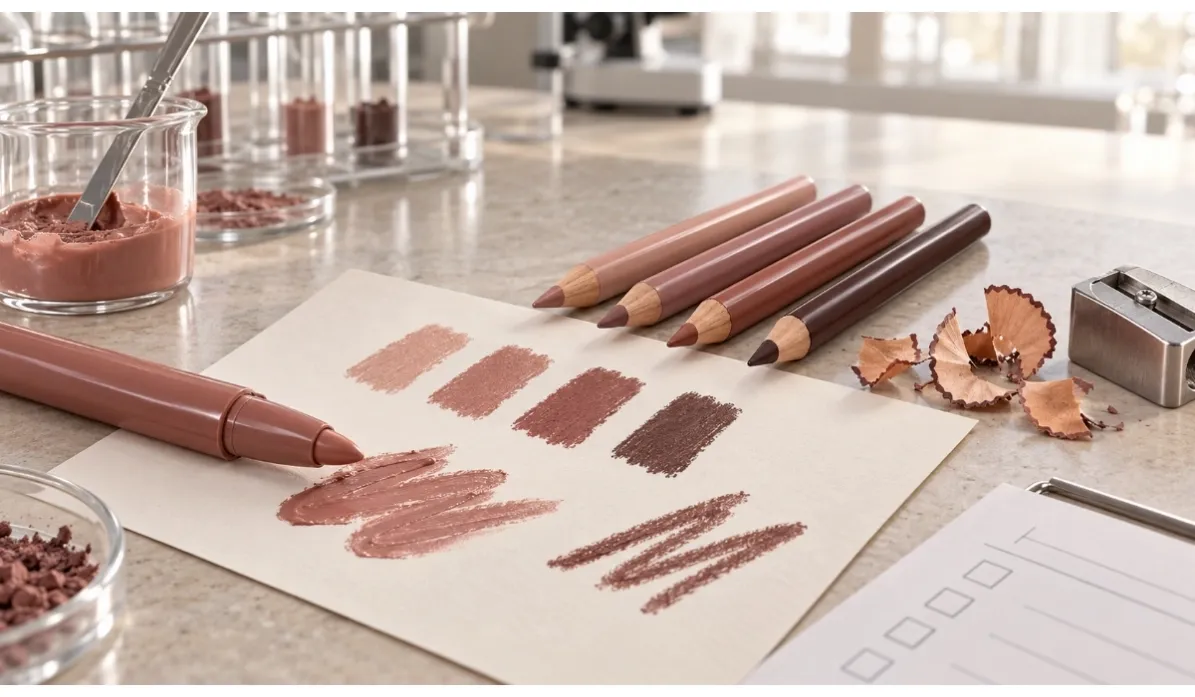
A buyer recently sent us physical lip liner samples for a new private label wooden pencil project.
The samples were valuable because they gave the laboratory real color standards to evaluate. However, they also revealed an important technical difference: the reference formula was extremely soft and could soften further under warm conditions.
That texture worked in the original product format. It could not simply be transferred unchanged into a wooden pencil.
A wooden lip liner must deliver comfortable glide and strong color payoff, but the lead also needs enough structure to survive manufacturing, shipping, sharpening and repeated use. This means that matching the reference requires more than reproducing its pigment color.
A Wooden Pencil Needs Structural Strength
The lead inside a wooden lip liner passes through several mechanical stages before it reaches the consumer.
It must remain stable while being formed, inserted into the wooden barrel, sharpened and transported. The tip should apply smoothly without bending, smearing against the wood or breaking too easily.
If the formula is too soft, several problems may appear:
- the lead can deform in warm conditions;
- the product may smear during sharpening;
- the tip may break or become uneven;
- the lead can separate from the wooden casing;
- the finished pencil may become difficult to pack and transport reliably.
Making the formula harder solves some of these problems, but going too far creates a different issue. The pencil may drag across the lips or release too little color.
The objective is therefore not to make the hardest possible lead. It is to find a workable balance between glide, payoff and structural stability.
Why Adjusting Hardness Can Change the Shade
Buyers sometimes expect a color to remain exactly the same when the texture is adjusted. In practice, formula hardness affects how much product transfers onto the skin.
A very soft pencil deposits a thicker film with relatively little pressure. A firmer wooden lead may produce a thinner application layer, especially in the first stroke.
This can change how the shade appears:
- a color may look lighter because less product is deposited;
- the undertone may appear different in a thinner film;
- the level of shine or matte finish can affect perceived depth;
- additional pressure or layering may be needed to reach the same intensity.
For this reason, matching the pigment mixture in the laboratory is not enough. The color must be evaluated in the final wooden pencil format.
The correct question is not only:
“Does the bulk formula match the reference color?”
It is also:
“Does the finished wooden pencil deliver the expected shade when applied normally?”
The Reference Defines the Target, Not the Entire Formula
In this project, the buyer’s physical samples remained the shade references. However, their softness could not become the only standard for the new product.
The development team needed to preserve the intended color direction while building a lead that could function properly inside wood.
This distinction should be agreed before sampling. Otherwise, the buyer may compare only the softness of the two products and conclude that the wooden pencil is different, even though the structural adjustment is necessary.
A useful development brief should separate four expectations:
- shade and undertone;
- glide during application;
- color payoff in one or more strokes;
- sharpening and temperature stability.
These requirements influence each other. Improving one may require a controlled compromise in another.
Learn more about why physical shade samples matter in private label lip liner development, especially when color needs to be matched across different pencil structures.
Why We Proposed Starting With Four Shades
The buyer’s planned range contained 12 unique colors. Instead of developing every shade at once, we proposed starting with four initial colors and preparing the remaining eight after the first group was evaluated.
The purpose was not simply to reduce the number of samples.
The first group allows both sides to establish how the adjusted wooden formula behaves across different color directions. It also helps define what the buyer means by acceptable glide, payoff and shade tolerance.
If all 12 shades were developed before the formula structure was accepted, the same texture adjustment might need to be repeated across the entire range.
A controlled first group provides more useful information:
- Is the wooden lead sufficiently stable?
- Does it sharpen cleanly?
- Is the application comfortable?
- Does normal application deposit enough pigment?
- Is the shade acceptable in one stroke and after layering?
Once these points are confirmed, the remaining shades can be developed against a clearer standard.
This staged approach is different from reducing the production MOQ. It is a way to control development before committing additional laboratory work.
Pencil Finish and Formula Approval Are Separate Decisions
The buyer was also reviewing the exterior finish of the wooden pencil, including whether the barrel surface should use a glossy coating.
That decision affects the appearance and handling of the packaging, but it does not determine whether the lead formula is technically suitable.
It is better to evaluate these elements separately:
- the formula sample confirms color, glide, stability and sharpening;
- the decorated pencil confirms barrel color, printing, coating and overall appearance.
Approving a beautiful barrel does not mean the lead formula has been approved. Likewise, an acceptable formula sample does not automatically confirm the final packaging finish.
Review our complete guide to what buyers should confirm before approving private label lip liner samples.
Define What Must Match—and What Must Adapt
An OEM manufacturer should not promise that a very soft reference formula can be transferred unchanged into every pencil construction.
A more professional approach is to explain which characteristics can be matched and which must be adapted to make the finished product reliable.
Before starting a wooden lip liner project, the buyer and manufacturer should agree on the priority:
- Is exact undertone the main requirement?
- Is one-stroke payoff more important than lead firmness?
- How soft should the application feel?
- Must the pencil withstand warm-weather distribution?
- What level of variation is acceptable after the structure is adjusted?
Clear answers help the laboratory develop a product that resembles the intended reference while still functioning as a wooden pencil.
The goal is not to reproduce the softest possible sample. It is to create a lip liner that delivers the intended shade, applies comfortably and remains reliable from production to consumer use.