
Sep 29, 2026Success Stories / Case Studies
Why Test Fragrance-Free Body Polish Samples First?
A U.S. body care buyer requested three fragrance-free samples based on the same formula chassis. The objective was to compare rinse-off feel and product performance before introducing scent.
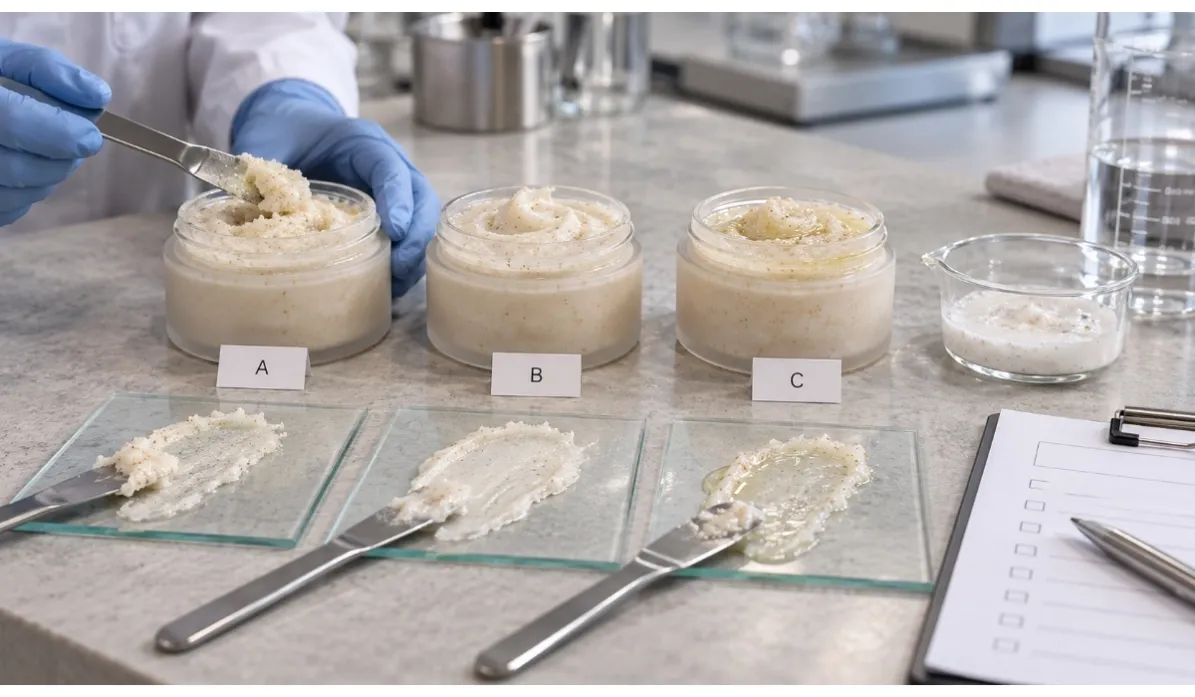
One recent body care inquiry did not begin with an ingredient list. It began with a detailed description of how the product should behave.
The U.S. buyer was developing a premium anhydrous body polish of approximately 180 g, with an intended retail price of around USD 36. The planned sales channels included the brand’s own website, TikTok Shop and Amazon US.
The performance brief was specific:
- strong and noticeable physical polishing;
- a clear balm or oil-to-milk transformation;
- a clean rinse;
- conditioned skin after use;
- no heavy or coated feeling.
These requirements sound compatible, but they create a real formulation challenge. Increasing the oil deposition may improve the conditioned finish, yet it can also make the product feel harder to rinse. A cleaner finish may feel more refreshing, but it may not provide the level of nourishment expected from a premium anhydrous formula.
Instead of producing one sample and asking whether the buyer liked it, the first sample round was divided into three fragrance-free texture directions.
Three Samples From the Same Base
The R&D team was asked to work from the closest existing formula chassis rather than develop three unrelated products.
This was important because the buyer needed to compare one main variable: the finish left on the skin after rinsing.
Sample direction | Intended experience |
|---|---|
Clean | Cleaner rinse with minimal residual film |
Balanced | A middle position between clean rinsing and conditioned skin |
Rich Deposition | More noticeable oil or conditioning deposition after rinsing |
The polishing strength and transformation behavior still needed to remain recognizable across all three versions. Otherwise, the buyer would be comparing three different product concepts instead of three controlled texture directions.
Why the First Samples Were Fragrance-Free
Fragrance is important in body care, but adding it too early can make technical evaluation less objective.
A pleasant fragrance can make one sample feel more luxurious even when its rinse-off performance is not the best match. A heavier fragrance may also make a formula seem richer, while a fresher scent can create the impression of a cleaner finish.
If every sample uses a different fragrance, it becomes difficult to know whether the buyer prefers the formula or simply prefers the scent.
Fragrance may also require an additional compatibility and stability review, particularly in an anhydrous system. Introducing it before the base texture has been selected can add another variable to every revision.
For this project, all three first-round samples were therefore kept fragrance-free. The scent would be selected only after the buyer confirmed the preferred texture and after-feel.
This is not a shortcut or an unfinished sampling process. It is a controlled way to make the first decision clearer.
A Benchmark Should Define One Performance Point
The buyer referenced an established body exfoliation product to explain the expected polishing strength.
That reference was useful, but only for one part of the brief.
It did not mean that the fragrance, ingredient story, packaging, texture and complete product experience should be copied. The benchmark simply helped the R&D team understand what the buyer meant by “strong polish.”
A good development brief should explain exactly which characteristic of a reference product matters:
- polishing intensity;
- transformation during use;
- viscosity;
- rinsing speed;
- immediate skin feel;
- finish several minutes after rinsing.
Without that distinction, a reference sample can easily be misunderstood as a request to reproduce the entire product.
How the Buyer Should Compare the Three Samples
The buyer should test all three versions under the same conditions. Using different amounts or changing the application method can distort the result.
For each sample, the evaluation should cover:
- how easily the product spreads before adding water;
- whether the polishing strength feels sufficiently noticeable;
- how clearly the balm or oil transforms during rinsing;
- how long the product takes to rinse away;
- whether the skin feels clean, conditioned or coated immediately afterward;
- how the skin feels again after several minutes.
The most useful feedback is not simply “Sample B is best.”
R&D needs to understand why it is better. For example:
- Sample A rinses well but needs slightly more conditioning.
- Sample B has the right balance but the transformation could be more obvious.
- Sample C feels too rich and leaves more residue than expected.
Comments like these give the laboratory a practical direction for the next adjustment.
Brands preparing their first development round can also review what should be confirmed before ordering skincare samples.
Existing Formula Chassis Does Not Mean No Customization
For this project, the supplier confirmed that the closest existing chassis could be used as the development starting point.
This reduces unnecessary development time, but it does not mean selecting a finished stock formula without evaluation. The base still needs to be adjusted against the buyer’s priorities and tested before approval.
The manufacturer’s minimum production quantity for this route was 2,000 bottles. The buyer’s initial estimate was 500–1,000 units, so the commercial quantity also needed to be clarified before bulk production.
Sampling can confirm whether the technical direction is suitable. It does not automatically remove the production MOQ.
The difference between using a proven base and creating an entirely new formula is explained further in our guide to stock formulas and custom formulations.
Make the First Sample Round Answer One Question
Trying to evaluate texture, fragrance, color, packaging and final claims at the same time often produces unclear feedback.
In this case, the first round had one purpose:
Which rinse-off finish best matches the intended premium body polish?
Once the buyer selects Clean, Balanced or Rich Deposition—or requests a precise adjustment between two versions—the project can move to fragrance selection, packaging compatibility and final sample confirmation.
A well-designed sample round does not need to answer every question at once. It should answer the most important question first.
BEGO Beauty supports private label development for waterless cleansing and anhydrous body care formulas, including formula matching, texture adjustment, fragrance development, packaging and sample evaluation.
If you are developing a body polish, cleansing balm or oil-to-milk product, a clear description of the desired transformation, rinse and after-feel is often more useful than a long ingredient wish list.