
Oct 14, 2026Success Stories / Case Studies
Should Every Product in a Body Care Line Use Glass Packaging
A five-product body care case shows why packaging materials should be selected by formula, size, usage and logistics—not appearance alone.
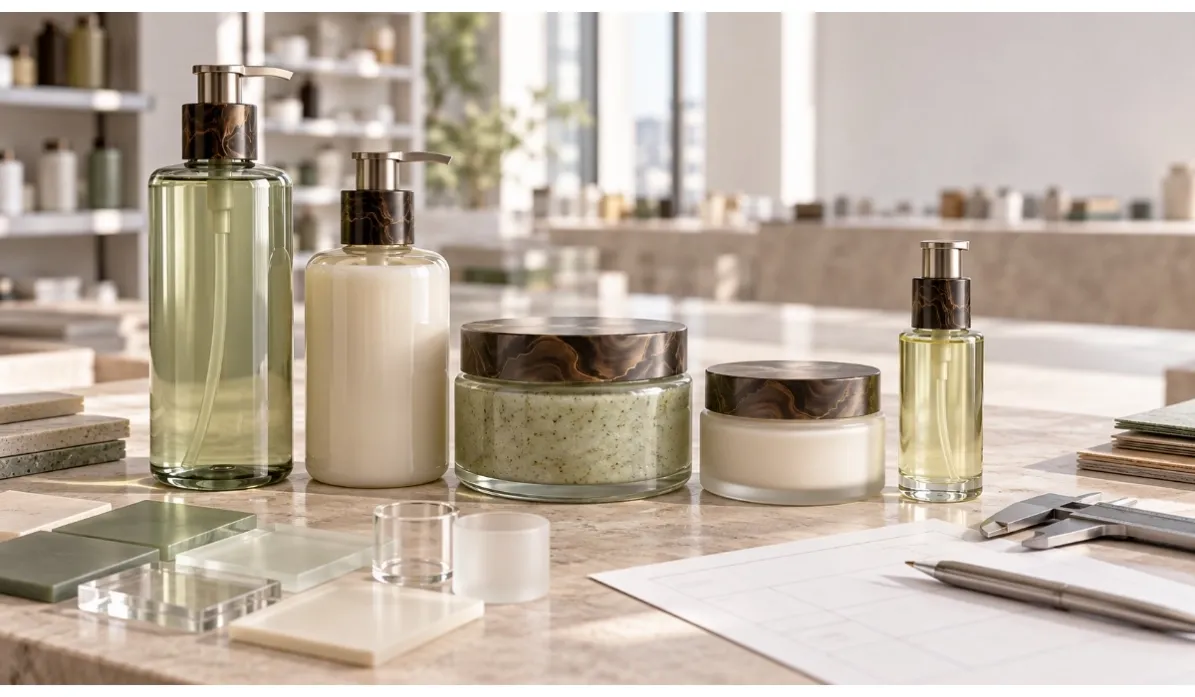
A recent private label body care project included five products:
- Body Wash
- Liquid Hand Soap
- Body Scrub
- Body Butter
- Body Oil
The brand wanted the entire collection to follow the same premium packaging direction: glass containers, coordinated colors and matching patterned closures.
Visually, the concept was clear. Technically, one important question remained:
Should all five products use glass simply because they belong to the same collection?
The answer depends on more than appearance.
Glass can work well for several body care products, but the material, capacity and dispensing system must be evaluated separately for each formula.
A Coordinated Collection Does Not Require Identical Materials
Using the same material across every product may seem like the easiest way to create a cohesive range.
In practice, visual consistency can also be created through:
- Coordinated container colors
- Matching pumps and caps
- Consistent label layouts
- Repeated decorative patterns
- Similar bottle silhouettes
- Unified matte, glossy or frosted finishes
The collection can still look consistent even when one product uses glass and another uses premium PET.
This is especially important when the product formats have very different requirements. A body oil, thick body butter and high-volume body wash should not automatically be placed into the same type of container.
Capacity Must Be Confirmed Before Selecting Glass
For this project, the available glass packaging options reached approximately 300 mL at the upper end.
In standard premium glass pump formats, a 120–150 mL bottle is already relatively substantial. Increasing the capacity also increases:
- Empty packaging weight
- Finished-product shipping weight
- Breakage exposure
- Carton protection requirements
- International freight cost
- Handling risk during fulfillment
This does not mean that a larger glass container is impossible. It means the brand must confirm whether the capacity, cost and logistics are suitable for the planned retail model.
Selecting a bottle based only on a reference photograph—before confirming the required fill volume—can lead to repeated packaging revisions.
Body Wash and Liquid Hand Soap
Body wash and liquid hand soap are normally high-consumption products. Buyers often expect a larger retail volume and a pump that can be used repeatedly.
When glass is considered, the following points should be evaluated:
- Required fill capacity
- Pump output per press
- Formula viscosity
- Bottle stability during pumping
- Use near a sink, bath or shower
- Risk of dropping the container on a wet surface
- Finished-product weight
- Protective shipping requirements
Glass may support a premium positioning, particularly for a countertop hand soap. However, it may be less practical for a large shower product or a brand that depends heavily on parcel delivery.
Premium PET can sometimes provide a similar visual direction with lower weight and breakage risk.
Body Scrub and Body Butter
Glass jars are often suitable for body scrub and body butter because these formulas usually require a wide opening rather than a pump.
The jar must still be matched to the formula.
For body scrub, the manufacturer should check:
- Oil leakage risk
- Seal and liner performance
- Compatibility with exfoliating particles
- Product pickup with wet hands
- Closure tightness
- Formula movement during transport
For body butter, the key considerations include:
- Formula firmness
- Filling temperature
- Jar opening diameter
- Headspace
- Inner lid or liner
- Consumer access to the remaining product
A visually attractive jar is not enough if the formula is difficult to fill, scoop or seal.
Body Oil
Body oil is generally easier to position in glass because it is often sold in a smaller volume and benefits from the premium weight and clarity of the material.
The dispensing system remains important.
Depending on the formula and intended application, the product may require:
- A treatment pump
- A lotion-style pump
- A dropper
- A reducer insert
- A controlled-pour closure
The manufacturer should test whether the closure delivers the expected dose without leakage or excessive product flow.
Formula and packaging compatibility should also be evaluated, especially when the body oil contains fragrance or decorative ingredients.
Glass Is Not Automatically More Premium in Every Situation
Premium packaging is not determined by weight alone.
A heavy glass bottle can feel luxurious, but it can also create problems if:
- The capacity is too small for the product category
- The pump does not match the formula
- The finished product becomes expensive to ship
- The bottle requires excessive protective packaging
- The container is inconvenient in the intended use environment
- The chosen size is unavailable at the required MOQ
Good packaging should support the product, brand positioning and distribution model at the same time.
A material that works well for body oil may not be the best choice for body wash. Using different materials where necessary is not a compromise if the overall design language remains consistent.
What Should Be Confirmed Before Requesting Packaging Quotations?
Before the packaging supplier prepares accurate options and quotations, the buyer should confirm the following information for each SKU:
- Product type
Confirm whether the formula is a wash, liquid soap, scrub, butter, lotion or oil.
- Required capacity
Specify the target volume in mL or product weight in grams.
- Formula viscosity
The dispensing system must be suitable for the actual formula texture.
- Preferred packaging material
Clarify whether glass is mandatory or whether premium PET may be considered for selected products.
- Intended sales channel
E-commerce, retail stores, hotels and professional channels may have different packaging and shipping priorities.
- Decoration requirements
Confirm whether the project requires custom color, frosting, printing, labels, water-transfer decoration or patterned closures.
- Expected order quantity
The packaging MOQ may be different from the filling MOQ and must be confirmed before finalizing the design.
Packaging Structure Comes Before Final Artwork
The bottle or jar should be confirmed before the final artwork is prepared.
Different components have different printable areas, curved surfaces and decoration limitations. Changing the container after the design file is completed may require the artwork to be adjusted again.
A reference image can communicate the desired style, but custom printing requires original, production-ready files. Learn more about why reference images are not enough for custom cosmetic packaging.
A Practical Development Sequence
For a multi-product body care collection, a more reliable sequence is:
- Confirm the five formulas and target capacities.
- Evaluate glass availability for each SKU.
- Compare weight, function, MOQ and shipping risk.
- Select the bottle, jar, pump and closure structures.
- Create a coordinated design system across the selected components.
- Prepare original artwork based on the actual printable areas.
- Produce packaging and formula samples.
- Confirm compatibility, dispensing and physical appearance.
- Approve the complete product before bulk production.
This sequence prevents the visual concept from moving too far ahead of technical feasibility.
Final Takeaway
Glass packaging can create a strong premium identity for a body care collection, but using glass for every product should not be treated as an automatic decision.
Body wash, hand soap, body scrub, body butter and body oil have different requirements for capacity, dispensing, handling and transportation.
The better approach is to select the most suitable packaging structure for each SKU and then create consistency through color, decoration, closure design and overall brand language.
A coordinated collection should look like one family. It does not have to use one material without exception.
BEGO Beauty supports private label body care development, including formula selection, packaging sourcing, compatibility review, custom decoration and finished-product production.